Nearly every hand in the room went up when the parents and teachers at October's Library Talk at the Fairfax Christian School were asked who had used ChatGPT, Claude, or Gemini in the past week. AI is already part of daily life, and it is already part of homework.
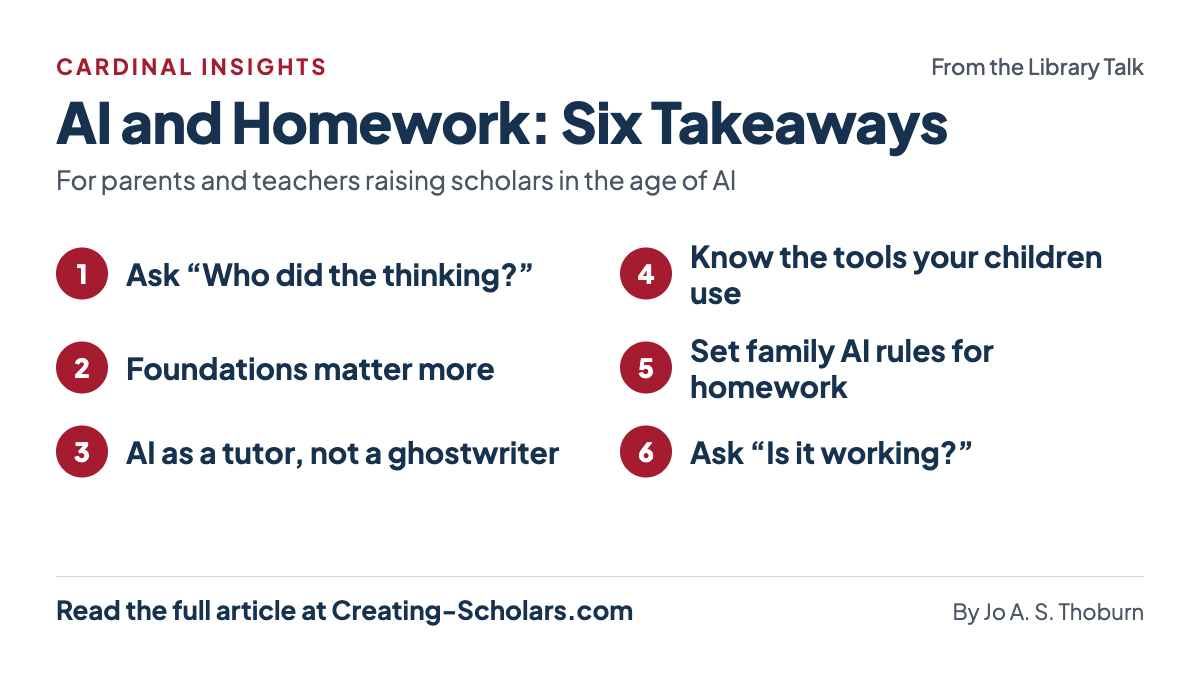
In "Creating Scholars in the Age of AI: What Every Future-Focused Parent Should Know," Jo A. S. Thoburn made the case that AI can be a remarkable tutor but a poor substitute for a child's own thinking. Mrs. Thoburn has turned the talk into a full article on The Scholars Report, the Creating Scholars blog for parents and students. It covers six ideas:
1. Ask "Who did the thinking?" School is a gym for the mind. A robot can't lift weights for you, and AI can't do the learning for a student.
2. Foundations matter more, not less. Math facts, grammar, and history are what let a student judge whether an AI answer is right.
3. Use AI as a tutor, not a ghostwriter. The article lists the kinds of requests that build learning and the kinds that skip it.
4. Know the tools your children use. At the Fairfax Christian School, students use Gemini through their Google Classroom accounts, and parents can set it up to work like a tutor at home.
5. Set family AI rules for homework. Ten practical tips, from "try first, then ask" to having your child explain an answer with the laptop closed.
6. Ask "Is it working?" A large 2026 study found that once students started using AI, their homework scores rose 18 percent, but their test scores fell 20 percent within six months.
The full article explains the research behind each point and includes a free printable of family AI rules for your refrigerator.