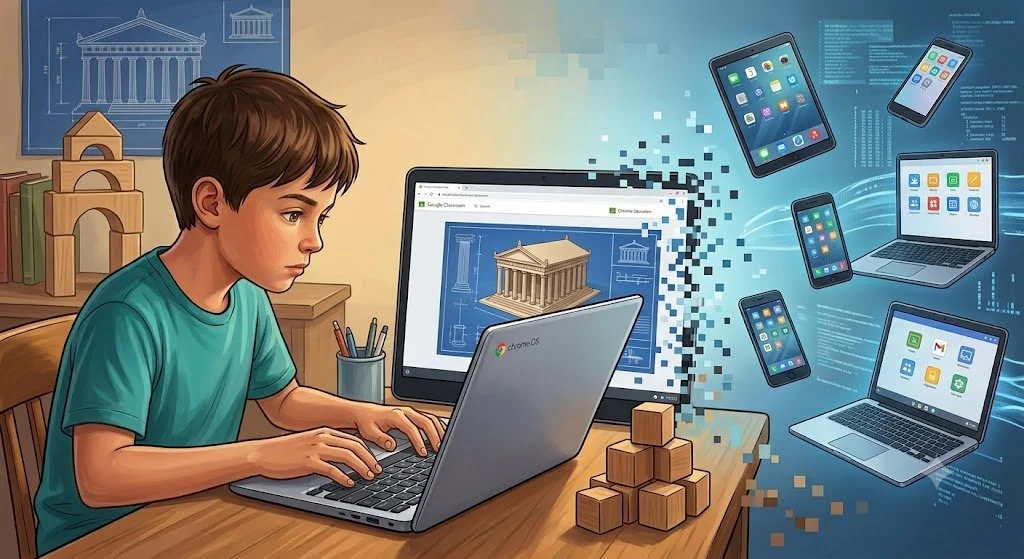
At the Fairfax Christian School, technology is utilized strictly as an intentional tool to enhance our time-tested curriculum, never as a substitute for deep thinking or traditional learning methods. True education involves the formation of the whole person—including moral, intellectual, and spiritual character—which requires a classroom environment entirely free from digital noise. While public school systems are just now implementing "bell-to-bell" personal device bans to curb chronic classroom distractions, the Fairfax Christian School implemented our mobile phone policy in 2003. Our established framework actively exceeds government school standards to preserve an unmatched environment of academic excellence.
Our daily protocols are structurally engineered to eliminate the enforcement loopholes and challenges that are frequently left behind:
Mobile Phones: We eliminate the temptation to sneak a peek entirely. All students bringing mobile phones to campus must physically turn them into the school office upon arrival, where they remain securely stored for the duration of the school day.
Smart Watch/Glasses: Our dress code policy only allows traditional mechanical watches. Digital watches and glasses of any kind are strictly prohibited.
Earbuds: Headphones, AirPods, and earbuds may not be used at school or on school buses.
Grade-Level Breakdown: Device Integration and Classroom Policies
To ensure our technology framework serves our core philosophy, we maintain strict, age-appropriate limits on when and how electronic devices enter the learning environment.
Lower School (Screen-Free Classrooms): In the lower school, our focus remains entirely on foundational, physical learning, meaning there is zero device time in the classroom. We protect our younger students from passive screen consumption during their standard instructional periods. The single exception to this rule is built directly into our hands-on science curriculum: lower school students may take scheduled, faculty-supervised trips to the school computer lab to engage with specific, targeted scientific modules and interactive lessons. Traditional academic videos that enhance our curriculum may be shown on a limited and approved basis.
Middle School (Structured Digital Tools): Middle school students are required to bring a fully charged Chromebook to school daily, but its active use during instructional time is strictly limited. Chromebooks are treated as specialized utilities rather than permanent desk fixtures. Students primarily use their devices to check assignments and track academic progress via our student information system, FACTS. Beyond basic access, middle schoolers are taught computer fundamentals and introductory programming to build essential technical literacy. To prevent digital drifting, teachers require students to keep their Chromebooks completely out of sight—stored away in their lockers or backpacks—unless they are actively being used for a specific, teacher-directed classroom activity.
High School (Advanced Preparation for Higher Education): The structured boundaries established in middle school apply uniformly to our high school students, though daily screen time may increase dynamically depending on the specific advanced courses a student selects. For example, students enrolled in AP Computer Science will conduct the primary portion of their coursework directly on a computer. Furthermore, we intentionally shift our technology focus toward advanced academic preparation. High schoolers are systematically taught how to use their computers to conduct rigorous, university-level research and to format and write comprehensive academic papers. By mastering these digital research standards early, our graduates are uniquely equipped with the technical discipline required to excel at top-tier universities.
Why We Use Chromebooks for Grades 5–12 A vital component of our technology blueprint is the mandatory requirement for all students in grades 5 through 12 to purchase and utilize a standard Chromebook, rather than bringing personal iPads or alternative computers to campus. This standardized mandate is enforced for several critical operational and safety reasons:
Preserving Parental Authority and Ownership: Unlike institutional programs where schools lease or distribute devices to students—thereby retaining root administrative controls and blurring the lines of domestic responsibility—we require parents to purchase the Chromebook directly. Because you purchase and own the device, you maintain ultimate oversight and stewardship over it. This structure preserves clear parental authority, ensuring you have the full right and capability to monitor your child's usage, establish home boundaries, or physically take the device away if needed, mirroring the behavioral accountability we expect at school.
Preventing Operating System Manipulation: Mobile tablets like iPads can easily be "jailbroken"—a process where the default factory operating system is deliberately altered. Jailbreaking allows students to bypass parental controls, eliminate school safety protocols, and download unapproved software. Chromebooks operate on a locked, secure architecture that prevents students from altering the root operating system or running unapproved background modifications.
Eliminating App-Based Distractions: Personal computers and tablets feature robust, built-in consumer app stores filled with non-educational gaming, social media, and hidden messaging platforms. Mandating a uniform Chromebook standard ensures that the hardware functions solely as an educational tool for research and specialized course content, completely removing the temptation to install local apps.
Promoting Classroom Equity and Readiness: Requiring identical hardware configurations guarantees that every student is on the exact same technical page when a teacher permits a digital activity. It eliminates classroom downtime caused by cross-platform troubleshooting, missing proprietary cables, or lost files due to a lack of automatic cloud backups. This uniformity keeps the focus entirely on the curriculum rather than the hardware.
Every element of this framework serves a single purpose: protecting the conditions under which real thinking happens. We are not anti-technology. We teach programming, research, and academic writing precisely because our graduates must command these tools with discipline and discernment. But we refuse to let a screen stand between a student and the hard, rewarding work of learning to think. Where government schools are only now catching up to boundaries we have held for years, we will continue to lead—not by adopting the newest device, but by keeping technology firmly in its place as a servant of the curriculum rather than a substitute for it. That is how we form students who are ready not only for top-tier universities, but for lives of wisdom, character, and purpose.
Want to read more about screen time and brain function? Read the Scholars Report — The Architecture of Attention: Developmental Erosion and the Data-Driven Realities of Screen Time.