Navigating the New F-1 Visa Rules: What Our Middle and High School Students Need to Know
Updated August 2026 · Based on the DHS final rule published July 17, 2026 (91 FR 44976), effective September 15, 2026.
The U.S. Department of Homeland Security (DHS) has finalized a major update to foreign-student visa regulations. Replacing the long-standing “Duration of Status” framework — the system that has governed F-1 students for roughly four decades — the federal government is moving F-1 students to a fixed period of admission beginning September 15, 2026. At Fairfax Christian School, we are committed to helping our international families stay fully compliant so our students can focus on academics. Here is a clear breakdown of how the new rule affects middle and high school F-1 students.
1. The End of “Duration of Status” (D/S)
In the past, F-1 students were admitted for “Duration of Status” (D/S). This meant your status remained valid for as long as you were enrolled full-time and making normal academic progress, without a specific expiration date on your Form I-94.
Under the new policy, D/S is eliminated. Every student will now receive a specific “Admit Until Date” on their Form I-94 record — the date by which you must depart, extend, transfer, or change status.
2. A 4-Year Cap on Stay
Your authorized period of stay will now match your Form I-20 program length, up to a maximum of 4 years.
Middle & High School Impact: Because secondary education spans multiple years, students whose academic journey extends beyond four years will need to apply for an Extension of Stay (EOS) before their fixed period expires.
Students are not allowed to repeat a year and can not transfer to another school within the first year.
3. A Shorter Post-Completion Grace Period
Once a student completes or graduates (or ends studies early), the departure-and-transition window has been shortened from 60 days to 30 days. Within those 30 days, the student must depart the U.S., transfer to a college/university, or change status. Students who fall out of status do not receive this grace period.
Key Action Items for FCS Families
Don’t Overlook Your Passport
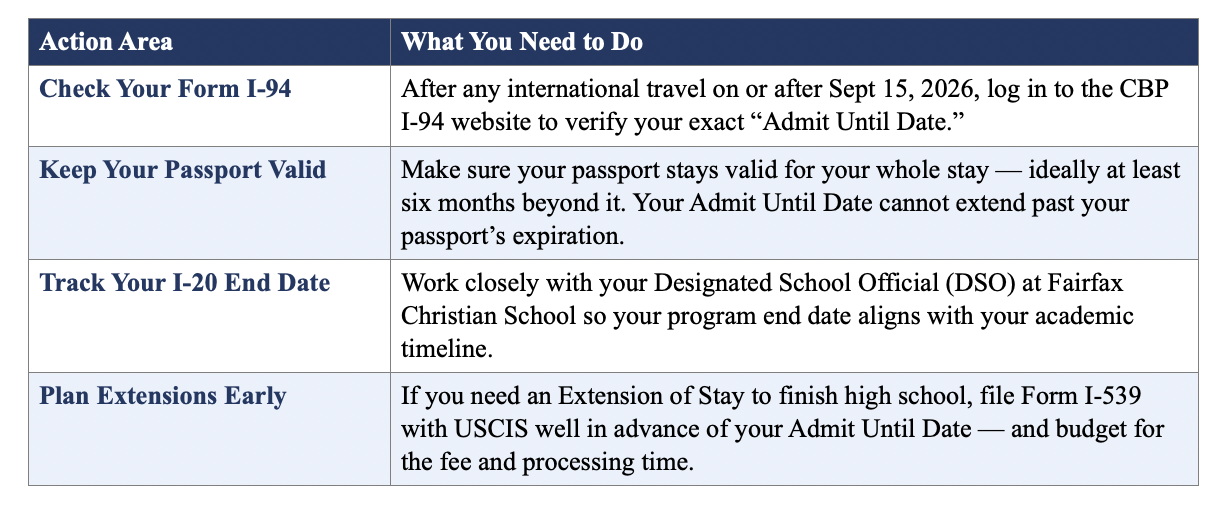
This is the most common thing families miss. When you enter the U.S., Customs and Border Protection (CBP) will not admit you for longer than your passport is valid. That means your “Admit Until Date” is set to the earlier of your program end date or your passport’s expiration date. A passport that expires in the middle of your program can quietly cut your authorized stay short — even below your I-20 end date.
Keep your passport valid at all times while in the U.S.; an expired passport puts your status at risk.
As a rule of thumb, keep it valid for at least six months beyond your intended stay.
Renew early. Passport renewals through your home country’s embassy or consulate can take weeks or months.
If your visa stamp is in an expiring passport, keep both the old and new passports together when you travel.
Your Visa Stamp Is Not the Same as Your Status
The visa stamp in your passport is only used to enter the country. How long you may stay is governed by the “Admit Until Date” on your I-94. A visa can expire while you remain in valid status inside the U.S. — but if you travel abroad, you will need a valid visa to return, and any re-entry on or after September 15, 2026 will issue you a brand-new fixed-date I-94. Always check it after you land.
What an Extension of Stay Now Involves
Under D/S, staying enrolled was enough. Under the new rule, an extension is a formal, discretionary request that USCIS can approve or deny:
It is filed with USCIS on Form I-539 (Application to Extend/Change Nonimmigrant Status).
It generally carries a filing fee and a biometrics appointment, and can take several months to process.
You must file before your Admit Until Date and keep maintaining status while the application is pending.
Because approval is no longer automatic, accuracy and filing early both matter more than they used to.
A Note for Current Students
If you were already in the U.S. and maintaining valid F-1 status before September 15, 2026, you transition into the new rules under federal guidelines. In general, you may remain through your I-20 program end date, up to a maximum of four years from the effective date (about September 15, 2030), plus a departure period (through roughly November 14, 2030). Taking an international trip and re-entering after September 15, 2026, will result in you being issued a brand-new fixed-date I-94 — so check it every time you return.
Good News for FCS Families
As a private school, Fairfax Christian is not subject to the rules that limit F-1 study at public schools (public high schools are capped at 12 months, and F-1 study at public elementary/middle schools isn’t permitted). Our students may hold F-1 status for their full program with us, subject to the new fixed-admission limits above.
Fairfax Christian School’s administration is here to help. If you have questions about your Form I-20 or upcoming travel plans, please schedule a check-in with our Dean of International Students today.
This summary is general information for FCS families and is not legal advice. Immigration rules and processing details can change, and individual situations differ. Always confirm your specific circumstances with your Designated School Official (DSO) and, where appropriate, a licensed immigration attorney, and verify details against official DHS/USCIS sources.
Sources: DHS Study in the States, “Fixed Time Period of Admission” FAQ; Federal Register 91 FR 44976 (July 17, 2026); U.S. Customs and Border Protection I-94 website.